01
Plan
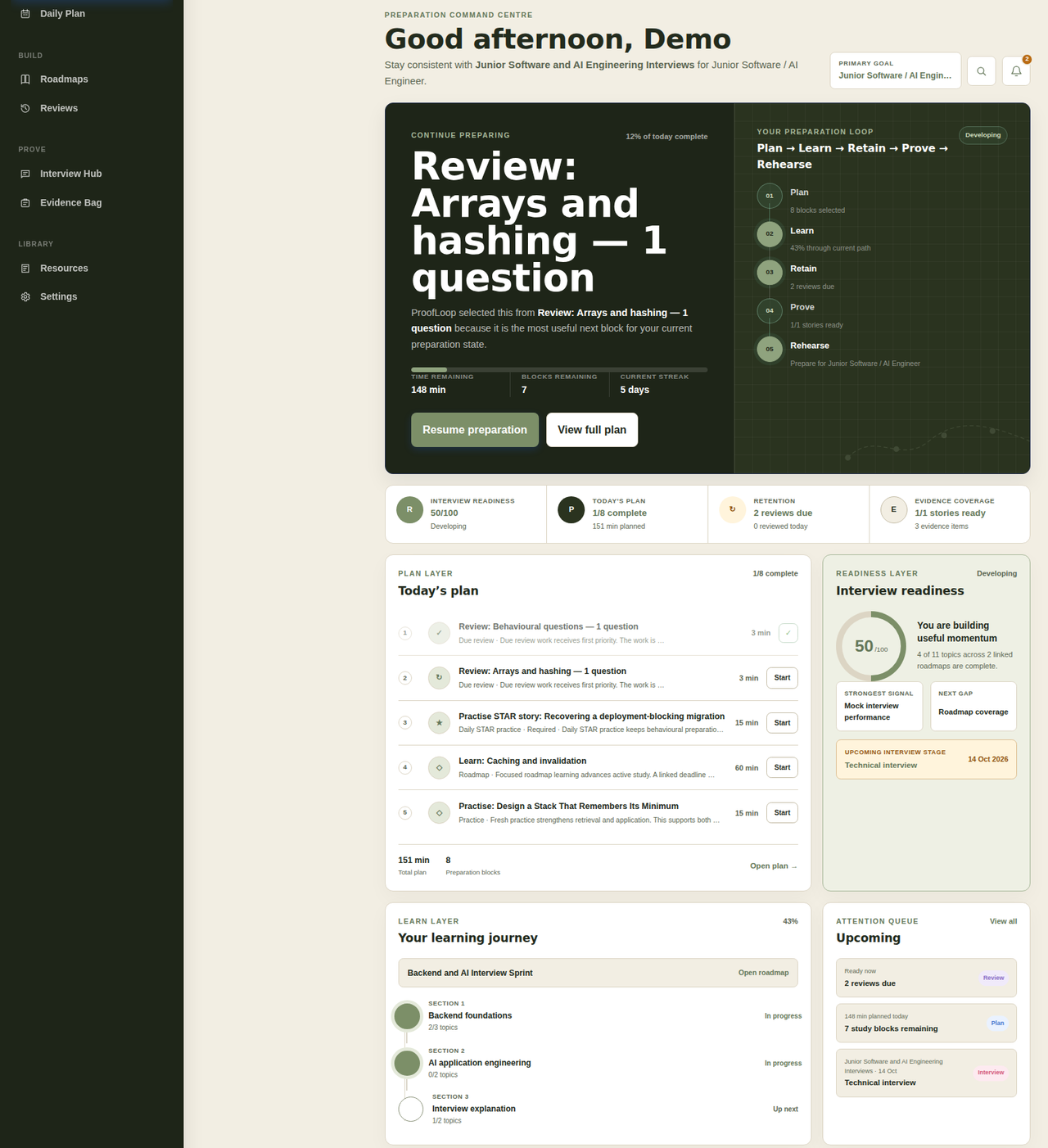
Users define a target role, company, interview stages, deadlines and weekly capacity. ProofLoop uses that context to prioritise preparation rather than serving a generic checklist.
Live product · Interview readiness workspace
An adaptive preparation workspace that turns a candidate’s target roles, learning resources, recall performance, interview deadlines and real experience into a focused daily plan and measurable readiness profile.
The product
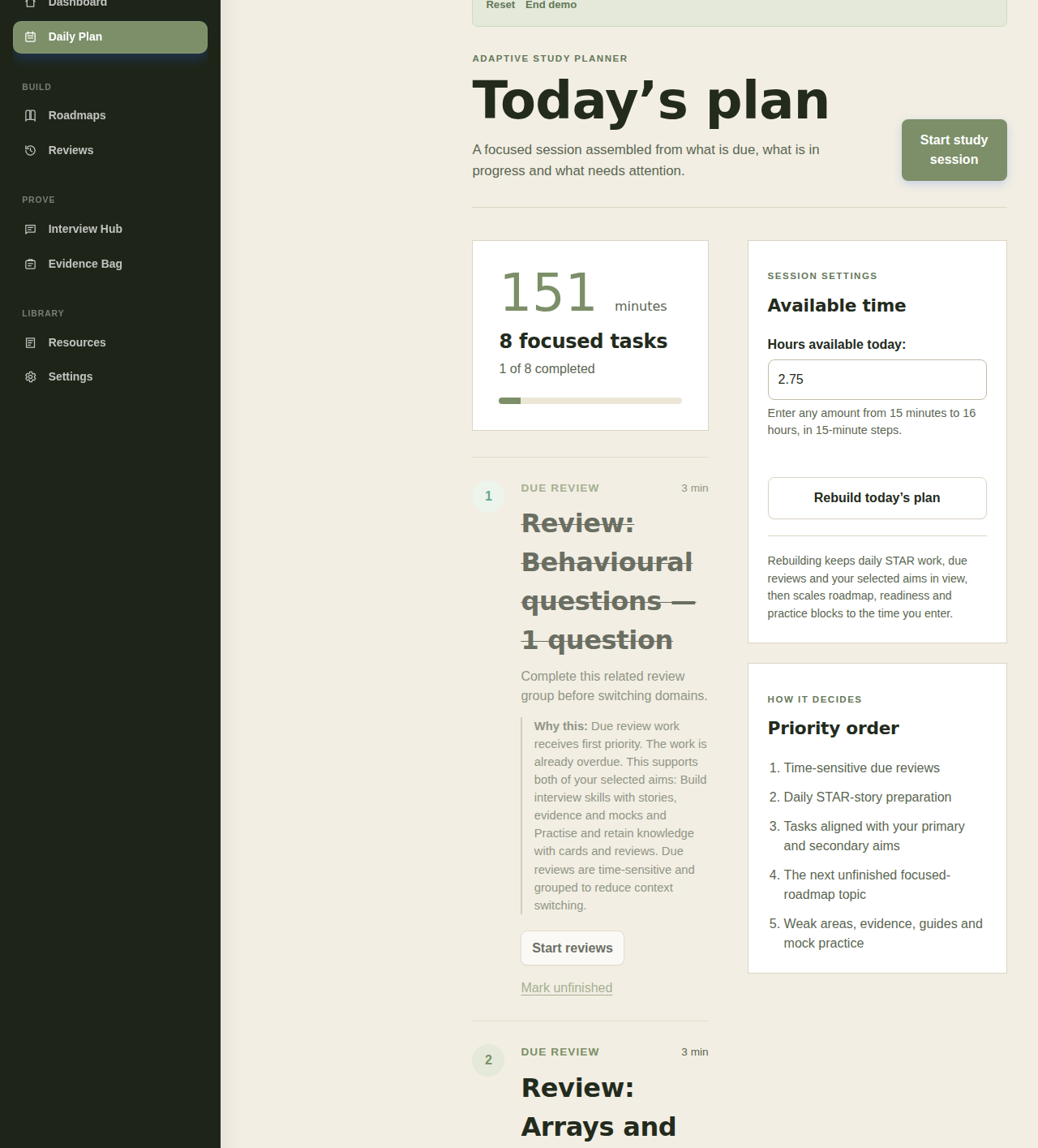
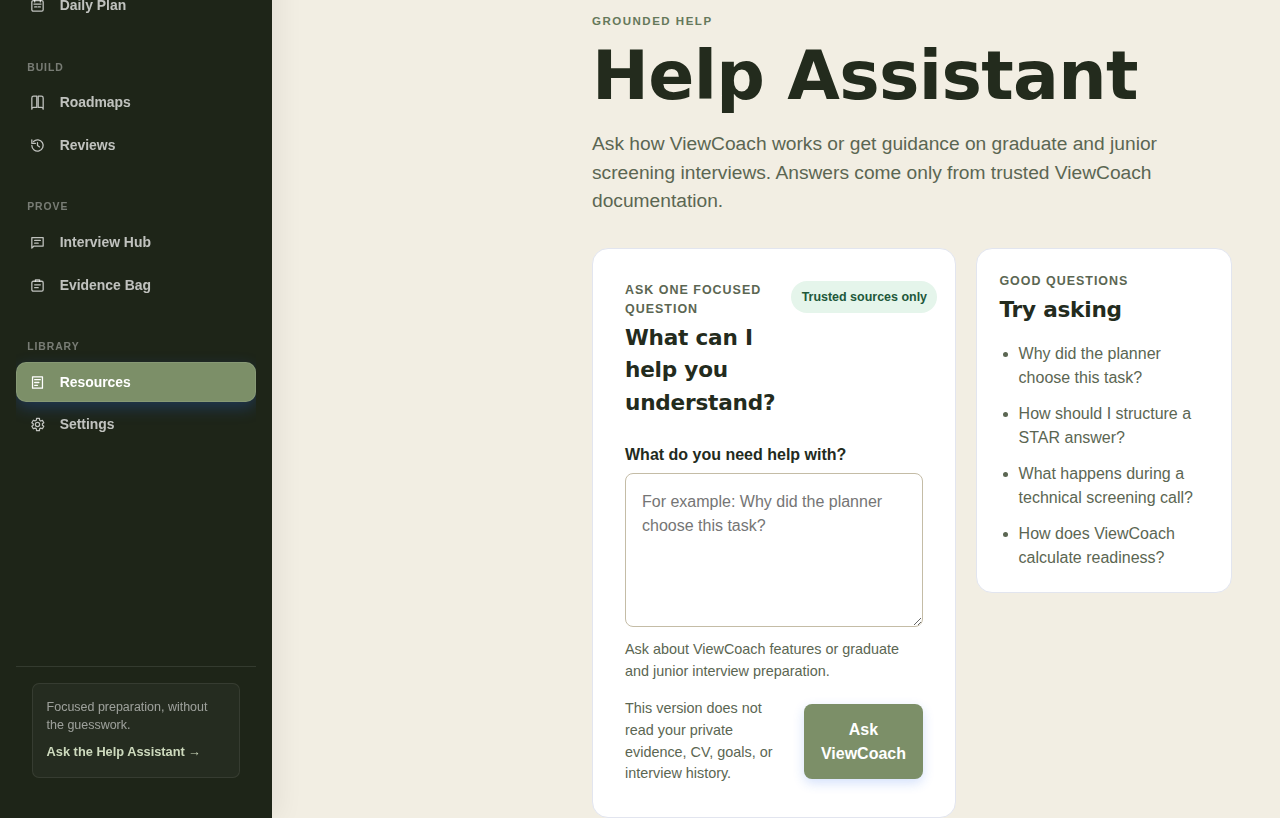
Screenshots from the application running on PostgreSQL with pgvector, using its built-in seeded demo workspace.
The problem
Candidates collect courses, playlists, notes, coding questions, project examples and behavioural stories, but still struggle to answer a more important question: what should I prepare today, and why?
Generic study plans ignore the role being targeted, the current interview stage, approaching deadlines, weak areas and the time actually available. Progress is often measured as content consumed rather than knowledge retained or evidence made interview-ready.
The product
ProofLoop connects activities that are normally treated as separate products.
01
Users define a target role, company, interview stages, deadlines and weekly capacity. ProofLoop uses that context to prioritise preparation rather than serving a generic checklist.
02
Built-in roadmaps, IBM SkillsBuild courses, YouTube playlists and custom learning paths share one progress system with topic notes, saved resources and focused learning sequences.
03
Technical, conceptual, behavioural and repository-debugging questions move through a structured preparation workflow and spaced-review schedule based on recall difficulty.
04
Users turn projects, work, coursework, leadership and technical incidents into reusable evidence, project explanations, decision records and interview-ready behavioural stories.
05
Timed technical, conceptual, behavioural, debugging and mixed mock interviews create a performance history that feeds back into preparation priorities and readiness.
Key differentiator
ProofLoop builds a daily plan from due reviews, recently difficult questions, unfinished roadmap topics, interview evidence gaps, goal relevance, deadlines and the user’s available study time.
Candidate activities receive explainable scores before OR-Tools CP-SAT selects a useful combination under explicit time, duplication, workload and context-switching constraints. A deterministic heuristic fallback keeps the planner available when the optimiser cannot return a solution.
Readiness model
The readiness profile combines multiple signals instead of presenting an unexplained score.
25%
Tracks completed topics across learning paths linked to the active interview goal.
25%
Measures whether prepared knowledge is current or accumulating as overdue recall work.
20%
Rewards a prepared library covering multiple interview formats rather than raw question volume.
20%
Uses recent answer-level confidence assessments to establish a rehearsal baseline.
10%
Reflects recent completed study sessions relative to the user’s preparation commitment.
Evidence system
ProofLoop treats interview evidence as a first-class product domain rather than a notes field.
Projects, work, coursework, leadership and technical incidents are stored with context, personal contribution, technologies, outcomes, lessons and supporting links.
Users prepare a quick pitch and two-minute explanation alongside architecture, key decisions, difficult bugs, testing, AI use, trade-offs, scaling and likely follow-up questions.
Evidence becomes reusable STAR-style stories with competencies, reflection and anticipated follow-ups, while completeness checks show what is still missing.
Evidence can be linked to roadmap topics, individual interview questions and specific job goals so the same experience can be framed appropriately in different interview contexts.
Bounded AI
The application uses AI in narrow workflows with explicit evidence and validation boundaries.
01
Gemini converts saved topic notes into editable technical or conceptual question drafts. Prompts prohibit unsupported facts, outputs must match validated JSON structures and drafts require user review before use.
02
The Help Assistant retrieves trusted documentation from PostgreSQL with pgvector, cites the supplied sources and refuses when the available evidence cannot support an answer.
03
Generation batches, retrieval results, citation payloads, latency and failures are persisted so important AI behaviour can be tested, reviewed and debugged rather than hidden behind a chat response.
Retrieval-augmented generation
The assistant is a RAG pipeline built around one rule: an answer is only shown when retrieved documentation supports it and every claim can be traced to a source.
01 · Ingest
Markdown is split along its headings, so each chunk keeps its section path (a parent › child heading path), with a size cap and overlap for long sections. Ingestion is idempotent and transactional: unchanged documents are skipped by content checksum,
renamed source files are re-matched by slug instead of duplicated, and chunk replacement is wrapped in select_for_update() so nothing reads a
half-rebuilt document mid-swap.
02 · Retrieve
Chunks are embedded with gemini-embedding-001 (1,536 dimensions) and stored beside the relational data in
PostgreSQL with pgvector. A query over-fetches three times the results it needs, then a similarity threshold filters them, so anything weak is dropped
before the model sees it.
03 · Generate
The prompt allows only the supplied context, treats instructions inside the question or documents as data (a defence against prompt injection),
and requires a [Source N] citation for each important claim. The page renders inline citations and source cards.
04 · Refuse
The assistant refuses (NOT_SUPPORTED) when the retrieved evidence is empty or below the threshold. Every citation is validated
against the chunks actually retrieved: an out-of-range or missing [Source N] is treated as unsupported, never defaulted to “cite everything”.
try/except wraps both retrieval and generation, so a retrieval-time failure, such as an embeddings outage, is logged and surfaced as a handled error rather than an unhandled exception.Architecture
Accounts, questions, reviews, roadmaps, planning, mock interviews, goals, evidence and knowledge retrieval have clear domain boundaries without premature distributed-system complexity.
Relational product data and vector embeddings live in one production database, with pgvector supporting cosine-similarity retrieval for grounded assistance.
Built-in curricula, imported courses, YouTube playlists and user-created roadmaps retain source-specific metadata while reusing the same topic and progress model.
Questions, imported roadmaps, notes, evidence, review state and generation batches are scoped to the authenticated user, with authorization behaviour covered by automated tests.
Daily plans, review attempts, mock sessions, generation batches and query logs create inspectable records instead of hiding important behaviour inside temporary requests.
pytest, Ruff, migration checks and GitHub Actions support a production deployment on Render with PostgreSQL health checks and environment-specific settings.
Product decisions
Each decision was weighed against the core workflow and recorded, using the user-created roadmaps feature as the example.
What this project demonstrates
ProofLoop demonstrates domain modelling across interconnected workflows, explainable recommendation logic, personalisation from each learner’s goals, weak areas, recall ratings and available time, optimisation under real constraints, secure multi-user data ownership, production AI boundaries, retrieval with vector search, and the ability to evolve a Django application without reducing it to a collection of CRUD screens.
Current scale
12
Role, skill and practice paths covering structured interview preparation.
419
Trackable learning units with notes, resources, progress and question-generation workflows.
4
Technical, conceptual, behavioural and repository-debugging preparation.
1
Learning, recall, evidence, rehearsal and planning feed into the same readiness system.